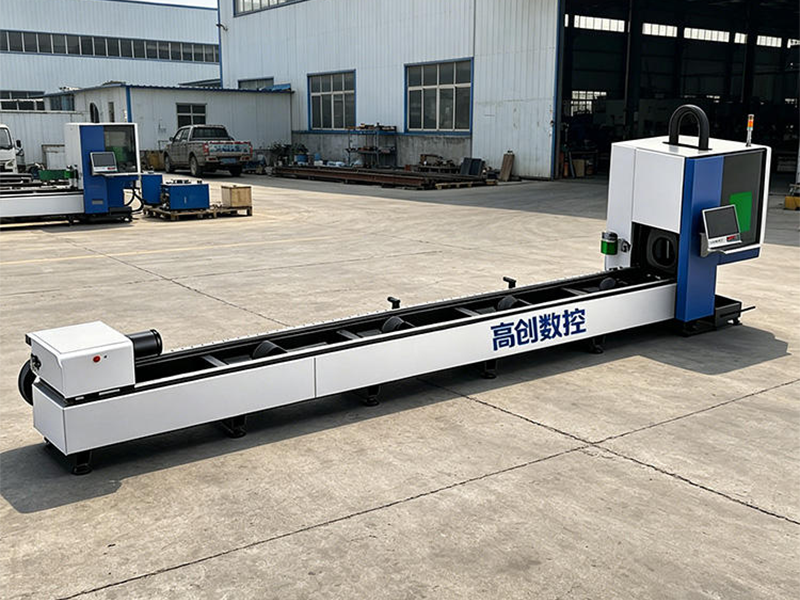
Here’s what a CNC tube laser actually does, where it delivers the most value, and what to weigh before investing.
What a CNC Tube Laser Actually Does
The workflow runs from CAD model to CAM programming, where software “unfolds” holes, slots, miters, and fishmouth profiles onto the tube surface. The CNC tube laser machine then executes loading, clamping, feeding, rotation, cutting, and unloading in one continuous cycle. The laser melts or vaporizes metal along the cut path, leaving a clean kerf with minimal dross. For most thin-to-medium-wall tube, the part comes off the CNC tube laser ready to weld.
The Real Advantages of CNC Tube Laser Technology
Vendors often lead with speed, and the numbers are impressive: throughput can be 5–10× faster than traditional methods. But the more consequential advantages of using a CNC tube laser are structural.
Precision and repeatability. Tolerances of ±0.1 mm are standard with a CNC tube laser, with joint gaps dropping below 0.4 mm—tight enough for single-pass welding without gap-filling wire.
Elimination of secondary operations. Holes, slots, miters, notches, and even bevels are cut in a single setup. The edge quality from a CNC tube laser is typically clean enough that parts skip deburring and go straight to assembly.
Material savings. Narrow kerf width and nesting software that optimizes part placement along the tube length reduce waste. Scrap rates tied to layout errors can fall dramatically when utilizing CNC tube laser cutting.
Design freedom without tooling. Because there is no physical die to change, switching between part designs on a CNC tube laser is a software change, not a setup event.
Where Tube Laser Cutting Fits Best
The technology is not a universal replacement for every tube-cutting scenario. It excels where tube geometry is complex, batch sizes vary, and downstream welding demands tight fit-up. Common high-value applications include:
- Automotive and transportation: exhaust systems, chassis structures, seat frames, roll cages
- Furniture and architectural metalwork: chair and table frames, railings, display fixtures
- Fitness and recreation equipment: strength-training frames, bike frames, playground structures
- Agricultural and heavy equipment: safety frames, hydraulic assemblies, structural tube components
- HVAC and fluid handling: ductwork connections, pipe fittings, manifold components
In shops where more than roughly 70% of cutting work is tube or pipe, a dedicated CNC tube laser often justifies itself over a flatbed machine with a rotary attachment, because the chuck system and tube-handling automation are purpose-built for the geometry.
What to Weigh Before Buying
The buying decision is less about “which brand” and more about matching machine configuration to your production reality.
Power is not the only spec that matters. A 1.5 kW machine handles thin-wall tube and small-batch furniture work; 3 kW covers medium-thickness tube and general fabrication; 6 kW and above enters thick-wall, high-volume territory. But beam quality (M²) can matter as much as raw kilowatts—a tighter beam produces faster cuts, cleaner edges, and better results on reflective materials like aluminum and copper.
Chuck configuration and tube range. Two-chuck systems are common, but heavy-duty or oversized tube may require four-chuck designs or specialized clamping. Confirm the machine’s round, square, and profile capacity against your actual part mix, not just the maximum diameter on the spec sheet.
Automation readiness. Automatic loading and unloading, or at minimum a ready interface for later automation, is increasingly a baseline expectation. The trend in the market is toward higher power and deeper process integration—drilling, tapping, and milling heads sharing the same platform—so a machine that cannot accommodate future automation may age quickly.
Software and CAD integration. The CAM layer is where productivity is won or lost. Direct import of 3D weldment files, automatic recognition of intersection profiles, and collision-avoidance handling reduce programming time and operator dependence.
The ROI Case in Brief
The payback math becomes concrete when you replace a multi-step manual process. A U.S. fitness equipment manufacturer processing 60,000 tube ends per year moved from band saw cutting, paper-template layout, and manual grinding to a 3 kW CNC tube laser. Tube-end processing time fell from 8 minutes to 45 seconds, the joint gap closed from 1.5–3.0 mm to 0.2–0.4 mm, and annual operating costs dropped by $235,310. The $165,000 machine was paid back in 8.4 months. Those numbers are not universal, but they illustrate the leverage: when labor hours, filler wire, grinding consumables, and scrap all decline together, the investment case moves quickly from “capital expense” to “capacity release.”
The Direction of the Technology
Tube laser cutting is not standing still. The market is growing at a healthy clip—high-speed tube laser systems are projected to expand at roughly 8.5% annually through 2031, with two-chuck systems growing even faster. The technical trajectory points toward higher power, more automation, and tighter integration of secondary processes into the laser platform. AI-assisted functions for parameter optimization and predictive maintenance are beginning to appear, and energy efficiency is becoming a competitive differentiator alongside raw cutting speed.
For fabricators, the practical takeaway is straightforward: tube laser cutting is no longer a niche tool for high-end aerospace or automotive suppliers. It has become the default production method for any operation where tube geometry is complex enough that manual layout and secondary grinding consume more time than the cut itself. The question is less whether the technology fits, and more where it fits first in your process.