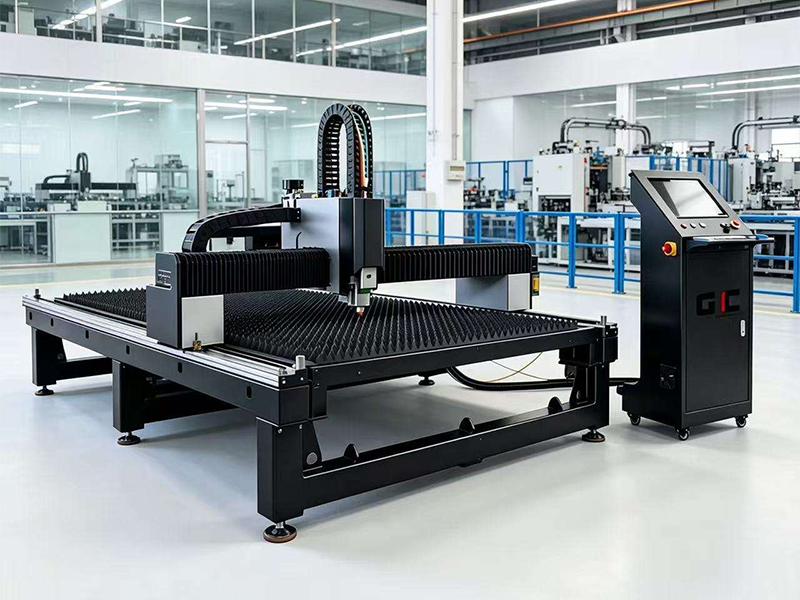
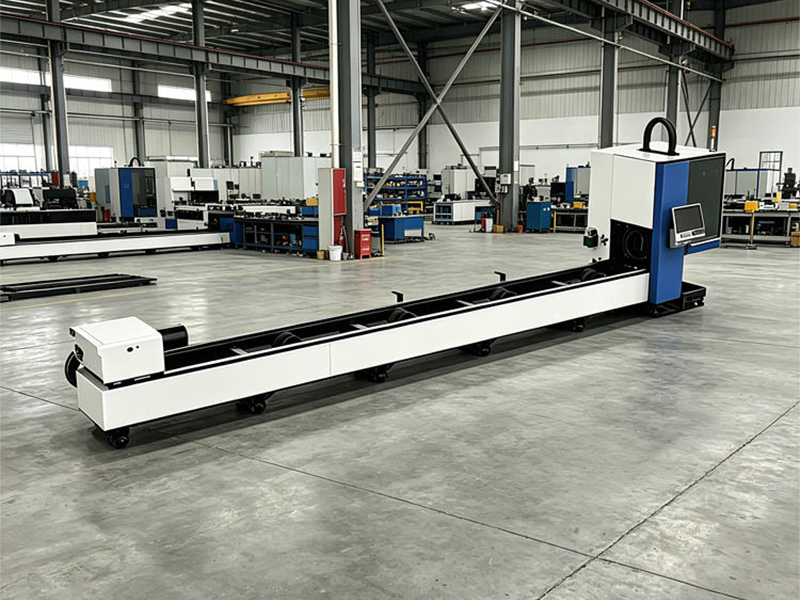
What Is Laser Cutting Tube?
Unlike flat sheet laser cutters, tube laser machines use rotating chucks to grip and spin the tube while the laser head moves along multiple axes. The laser melts or vaporizes metal along programmed CAD paths, and assist gas blows away molten material to leave clean edges. It handles round, square, rectangular, oval and special-shaped profiles, not just simple straight pipes.
Modern fiber tube lasers can combine multiple operations: cutting to length, angled miter cuts, complex coping for welded joints, hole arrays, decorative cutouts and part marking — all without re-fixturing the workpiece.
How Does a CNC Tube Laser Work?
- CAD Programming: Engineers upload DXF or STEP files into the machine control software, nesting parts to save material.
- Automatic Loading: Raw tubes are fed into pneumatic or hydraulic chucks; many models support automatic loading and unloading for unattended production.
- Rotation & Tracking: Chucks rotate and advance the tube, while capacitive sensors maintain consistent laser focus distance.
- Лазерная резка: Fiber laser delivers a concentrated beam. Oxygen is commonly used for carbon steel; nitrogen delivers oxidation-free edges for stainless steel and aluminum.
- Unloading & Sorting: Finished parts drop out, ready for welding, assembly or powder coating, with minimal deburring needed.
Key Benefits of Fiber Laser Cutting Tube
1. Superior Precision & Tight Tolerances
Quality fiber tube lasers reach ±0.03mm positioning accuracy. Clean, narrow kerf and repeatable geometry mean tube parts fit perfectly during welding, reducing gaps, filler metal and rework. This is critical for architectural metalwork, EV components and medical tubular parts.
2. One Machine Replaces Multiple Traditional Tools
A single CNC tube laser replaces band saws, drill presses, milling machines and coping tools. Fabricators cut holes, slots, notches and compound bevels in one run. What once took 3–5 separate setups now finishes in one cycle, cutting lead time dramatically for custom and batch orders.
3. Wide Material & Profile Flexibility
Fiber laser tube cutters process most common industrial metals:
- Carbon steel / mild steel (construction, frames, machinery)
- Stainless steel (railings, food equipment, decorative metal)
- Aluminum (lightweight structures, EV chassis, heat exchangers)
- Brass, copper and alloy steel (plumbing, electrical, custom hardware)
They support a wide range of tube diameters and wall thicknesses, suitable for both thin decorative tubing and heavy structural profiles.
4. Less Waste & Lower Long-Term Cost
Smart nesting software optimizes part layout on tube stock to cut scrap rates. Burr-free laser edges reduce secondary finishing labor. While tube laser equipment has a higher upfront investment, fabricators gain faster turnaround, fewer rejected parts and capacity to take high-mix custom jobs, improving ROI within 1–3 years for active tube shops.
5. Automation Ready for Lights-Out Fabrication
Mid-range and premium tube laser models feature auto loading, auto unloading, nozzle changing and edge detection. They integrate seamlessly with robotic welding cells, supporting Industry 4.0 workflows for high-volume automotive, furniture and energy projects. This helps factories ease pressure from skilled welder shortages.
Top Industries Using Laser Cutting Tube
- Automotive & New Energy: Exhaust pipes, roll cages, chassis frames, battery support tubes
- Furniture & Interior: Metal chair frames, table bases, shelving, decorative tubular designs
- Construction & Architecture: Stair railings, balustrades, structural frames, canopy supports
- Agricultural & Heavy Machinery: Tractor frames, harvester brackets, protective tubing
- Sports & Fitness: Gym equipment frames, bicycle tube parts, playground structures
- HVAC & Energy: Heat exchanger tubes, solar mounting frames, piping assemblies
- Medical & Aerospace: Precision lightweight tubular components requiring strict tolerances
Laser Cutting Tube vs Traditional Tube Fabrication
| Особенность | Laser Cutting Tube | Saw + Drill + Manual Coping |
|---|---|---|
| Время настройки | One setup for mixed features | Multiple fixtures, re-clamping |
| Качество кромок | Clean, minimal burr | Rough cuts, heavy deburring required |
| Сложные формы | Compound angles, interlocking joints, patterns | Limited geometry, slow custom work |
| Repeatability | Consistent across batches | Human error risk |
| Labor demand | Low after programming | High skilled labor |
| Lead time | Fast for prototypes & small batches | Slow for custom designs |
What to Consider When Choosing a Tube Laser Cutter
- Tube diameter & weight capacity: Match your most common pipe size (small 20mm tubes up to large 300mm+ heavy profiles).
- Мощность лазера: 1500W–2000W for thin mild steel; 3000W–6000W+ for stainless steel, aluminum and thicker walls.
- 2D vs 3D (5-axis) capability: 2-axis models handle standard miter cuts and holes for general fabrication. 3D 5-axis tube lasers do true bevel cuts for weld prep and complex multi-face geometry, ideal for high-end automotive and aerospace work.
- Auto loading system: Essential if you run long production runs.
- Совместимость программного обеспечения: Check whether the control system reads your CAD files and supports efficient nesting.
Заключительные мысли
Laser cutting tube is not just an upgrade — it changes what metal fabricators can design, quote and deliver. For custom metal shops, furniture manufacturers, automotive suppliers and structural steel firms, fiber CNC tube lasers unlock faster delivery, better fit-up, lower waste and more creative tubular designs that traditional methods simply cannot match.
If your workshop processes metal tubes and pipes regularly, upgrading to a reliable fiber tube laser cutter will help you win more orders, reduce bottlenecks and stay competitive in a fast-changing metal fabrication market.
FAQ (for SEO)
Q: Can a fiber laser cut aluminum tube? Yes. Modern fiber lasers handle reflective metals like aluminum, brass and copper efficiently with optimized cutting parameters and assist gas settings.
Q: Is laser tube cutting expensive? Per-piece cost is competitive for medium and high volumes. Savings from reduced labor, scrap and secondary operations offset machine investment over time.
Q: What file format do I need for laser tube cutting? DXF and STEP files are standard for most CNC tube laser control software.
Word count: ~780 Target keywords naturally distributed: laser cutting tube, CNC tube laser, fiber laser pipe cutting, tube laser cutter, pipe laser cutting