Introduction
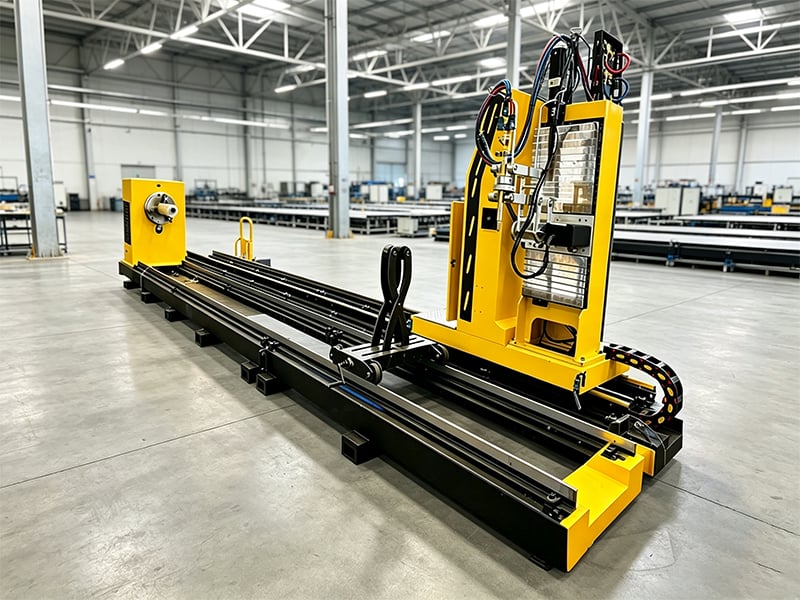
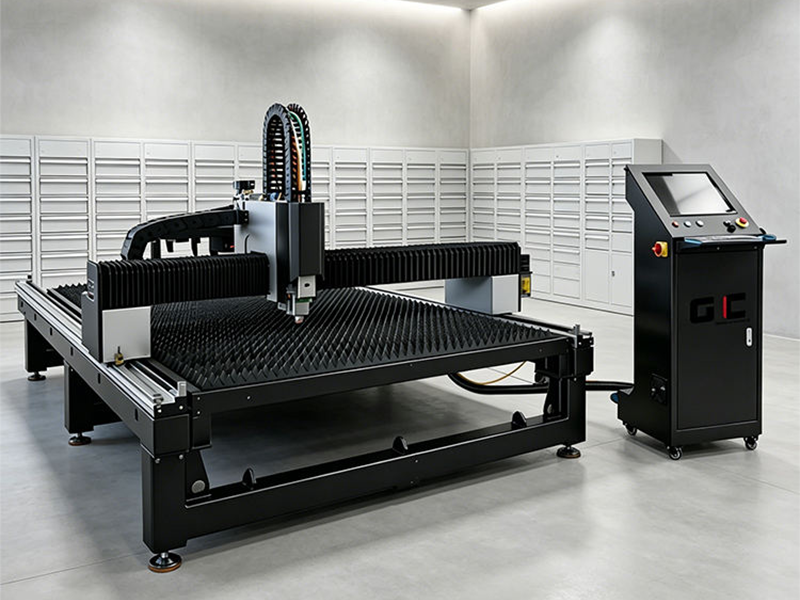
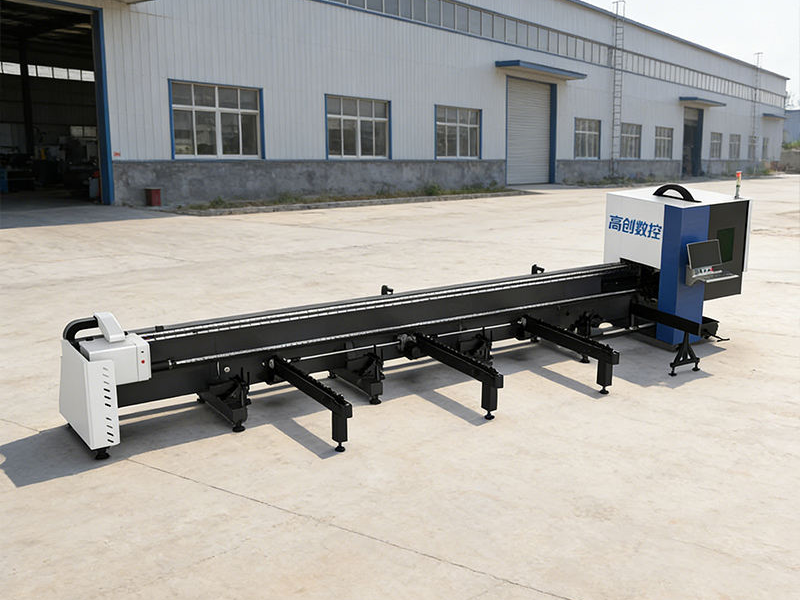
A fiber laser tube cutter is a CNC-controlled industrial machine specially built for cutting metal tubes and profiles. It automatically clamps, rotates and cuts round tubes, square tubes, rectangular tubes, channel steel, angle steel and other special-shaped profiles. It can complete straight cuts, mitre cuts, holes, notches, slots and complex 3D outlines in one setup, eliminating most secondary grinding and machining work.
In this guide, we will cover how it works, core advantages, suitable materials, main industries, key buying factors and common FAQs for factory owners and purchasing managers.
How Does a Laser Tube Cutter Work?
Most commercial laser tube cutters today adopt fiber laser sources, which deliver a concentrated, high-energy laser beam through an optical fiber to the cutting head.
- Raw long tubes are loaded automatically or semi-automatically onto the machine’s feeding rack.
- Multi-chuck clamping systems fix and rotate the tube steadily during cutting; 3-chuck models are widely used for long tubes to minimize leftover tail material.
- The CNC system reads your DXF drawings, controls tube rotation and cutting head movement synchronously.
- The laser melts or vaporizes the metal, while auxiliary gas (oxygen, nitrogen or compressed air) blows away molten slag.
- Finished parts drop out automatically, ready for welding or assembly.
Compared with CO₂ laser tube cutters, fiber versions run at higher cutting speed, consume less electricity and require simpler daily maintenance, which makes them the mainstream choice for metal tube processing.
Core Benefits of Laser Tube Cutting
1. Précision de coupe exceptionnelle et bords nets
Typical positioning accuracy reaches ±0.03 mm. The narrow kerf and small heat-affected zone produce nearly burr-free cuts. Most finished pieces go straight to welding without deburring, saving lots of labor time on post-processing.
2. Flexible one-step forming
One machine replaces sawing, drilling, notching and marking. You can cut angled joints, interlocking notches, mounting holes and custom contours without expensive custom dies. It fits both small-batch custom orders and mass production perfectly.
3. Lower material waste & better ROI
Advanced zero-tail or short-tail chuck designs greatly reduce leftover tube scrap. High nesting software optimizes layout on full-length 6m / 9m /12m pipes. For steel-intensive workshops, material savings directly lift profit margins.
4. High automation, less labor dependence
Automatic loading, unloading and sorting options are available. One operator can run multiple machines. This helps manufacturers ease labor shortages and stabilize delivery schedules.
5. Wide material compatibility
Fiber laser tube cutters handle most common industrial metals:
- Acier au carbone
- Acier inoxydable
- Alliage d'aluminium
- Laiton et cuivre
- Galvanized pipe
Main Industries Using Laser Tube Cutters
- Automobile et moto: Chassis frames, roll cages, exhaust pipe brackets, tubular structural parts
- Fitness & sports equipment: Gym machine frames, bicycle frames, rack structures
- Architectural metal & construction: Handrails, railings, curtain wall supports, steel frame components
- Machines agricoles: Harvester and tractor frames, spray pipe assemblies
- Furniture & display: Stainless steel furniture frames, exhibition stands, decorative metal profiles
- Medical equipment: Lightweight precision frames for hospital beds and rehabilitation devices
- Elevator & engineering machinery: Structural pipe parts and support frames
Key Specs to Check Before Buying a Laser Tube Cutter
When comparing suppliers, focus on these practical parameters instead of only laser power:
- Puissance du laser: 1500W–3000W for thin & medium tubes; 4000W–12000W for thick-wall heavy profiles
- Tube capacity: Min / max diameter, maximum tube length (6m, 9m, 12m are common)
- Type de mandrin: 2-chuck for standard jobs; 3-chuck for long tube zero-tail cutting
- Supported profiles: Round, square, rectangular, angle iron, channel steel, oval tube
- Loading system: Manual, semi-auto or full automatic bundle loading
- Control software: CypCut or similar professional tube cutting CAM software, easy for importing DXF files
- Safety & after-sales: Protective enclosure, water chiller, local service and warranty terms
Common FAQ
Q: Can a laser tube cutter do bevel cuts?
A: Yes. Bevel cutting laser tube cutters with rotating cutting heads make V-grooves and weld preparation bevels directly, which is very popular for structural steel and heavy engineering projects.
Q: What is the difference between a tube laser cutter and a flat sheet laser cutter?
A: Sheet lasers focus on 2D flat plates. Tube laser cutters are equipped with rotating chucks, special tube nesting and anti-vibration structure, built specially for hollow profiles. A combined sheet & tube laser machine is available if you process both plates and pipes.
Q: Is fiber laser better than CO₂ for tube cutting?
A: For metal tubes, fiber laser is faster, more energy-efficient and lower-maintenance. CO₂ tube lasers are mostly reserved for non-metal materials or ultra-thin high-precision special applications now.
Conclusion
If your workshop still relies on slow multi-step pipe fabrication, upgrading to a reliable laser tube cutter is one of the clearest ways to raise output quality, shorten lead times and cut overall production cost. It gives you greater flexibility to accept custom tubular parts orders while keeping competitive pricing.
Whether you run a small metal fabrication shop or a large OEM factory, matching laser power, tube size range and automation level to your actual workpiece mix is the key to maximizing ROI.
If you need a quote or technical proposal for a CNC laser tube cutter, contact our team today.