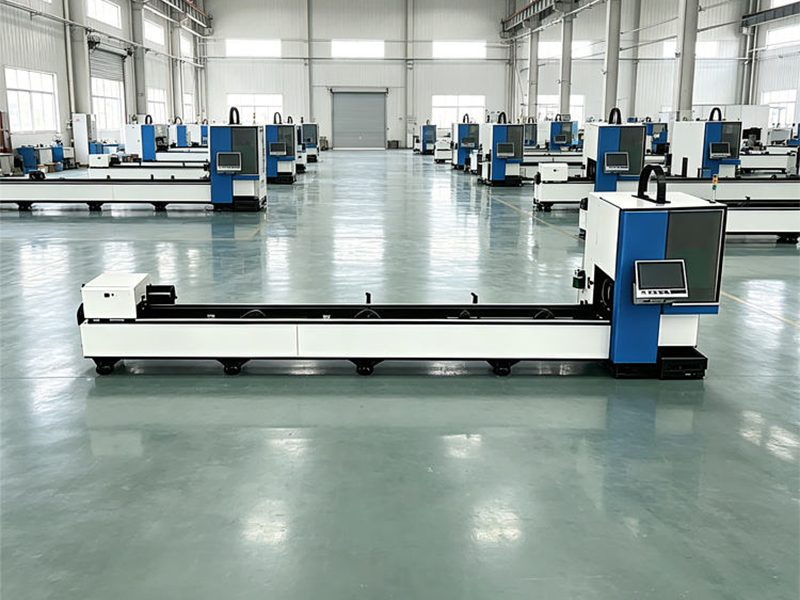
Corte de tubos con láser: cómo el corte de tubos con láser de fibra mejora la precisión y la eficiencia en la fabricación
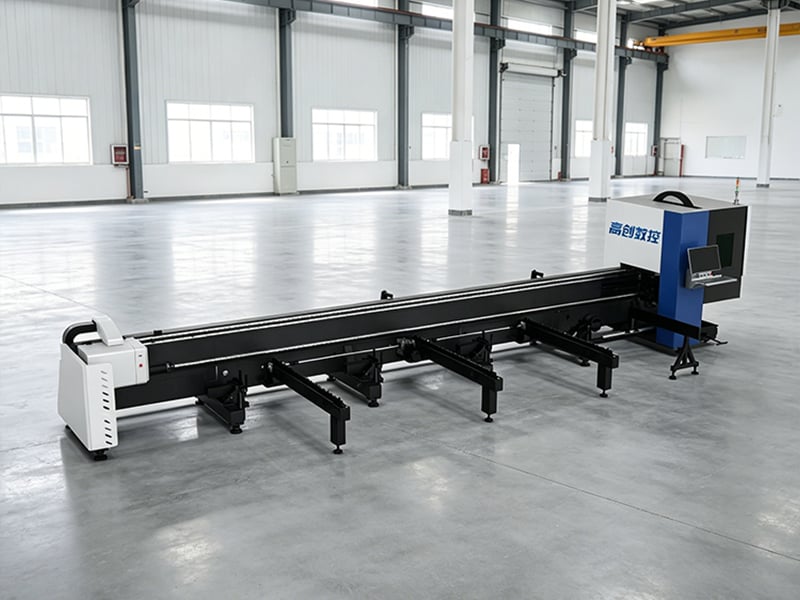
Fiber laser tube cutting is a CNC-controlled, non-contact cutting process. The machine uses pneumatic chucks to clamp and rotate tubes while the laser head moves along programmed paths. It completes straight cuts, holes, slots, bevels, intersecting joints and complex contours in one clamping cycle, instead of moving workpieces between different machines.
How Does Laser Cutting Tube Work?
A fiber laser source generates a high-energy laser beam, which focuses on the tube surface. The beam melts or vaporises the metal, while assist gas — oxygen, nitrogen or compressed air — blows molten slag away to form a clean cut. The multi-axis CNC system synchronises tube rotation, feeding and laser head movement to follow 3D profiles, not just flat 2D shapes.
This is the key difference between a sheet laser cutter and a dedicated tube laser. Sheet lasers cut flat plates on X and Y axes. Tube lasers add rotary axes to handle 3D tubular profiles, making them suitable for round, square, rectangular, oval tubes, angle steel, channel steel and other structural profiles.
Most industrial laser tube cutters achieve positioning accuracy of ±0.05–0.1 mm, with narrow kerf around 0.1–0.3 mm. The heat-affected zone is small, so thin-walled tubes are less likely to deform during cutting.
Materials & Profiles for Laser Cutting Tube
Modern fiber laser tube cutters work with a wide range of common metals: carbon steel, stainless steel, aluminum, galvanized steel, brass and copper. The suitable wall thickness depends on laser power; 1500W to 6000W models are the most popular for general metal fabrication jobs.
Supported tube shapes include:
- Round tube
- Tubo cuadrado
- Tubo rectangular
- Oval and special-shaped extrusion
- Angle iron, channel steel and other open structural profiles
That flexibility makes laser cutting tube ideal for custom parts, small-batch prototypes and mass production alike.
Key Benefits of Laser Cutting Tube
First, it reduces extra finishing work. Laser-cut edges are smooth with little burr, so many parts skip deburring and grinding before welding or assembly. This cuts labour time and lowers the risk of human errorTRUMPF.
Second, it improves design freedom. Fabricators can run complex intersecting joints, tapered bevels and patterned holes that are hard or impossible to make with saws and drill presses. Engineers can design stronger, lighter tube frames without limiting themselves to simple straight cuts.
Third, automated loading and unloading options reduce manual handling. With automatic feeders, the machine processes full-length tubes continuously, raising output and shortening lead times. Advanced nesting software also optimises layouts to cut down material waste, which is critical for expensive stainless steel and aluminum stock.
Fourth, no cutting tool wear. Since it is non-contact processing, there are no saw blades to replace or sharpen, lowering long-term maintenance costs.
Main Industries Using Laser Cutting Tube
Laser cutting tube is widely adopted across many manufacturing sectors:
- Fitness equipment: frame tubes, weight racks and gym accessories
- Automotive and EV: chassis frames, battery brackets and exhaust components
- Construction & steel structure: railings, trusses, support frames
- Medical equipment: hospital beds, rehabilitation frames
- Agricultural machinery, storage racks and bicycle frames
FAQ About Laser Cutting Tube
Q1: Can a laser tube cutter cut square tube? A1: Yes. With proper chuck jaws and programming, it processes square, rectangular and irregular profiles smoothly.
Q2: What file format do I need for tube laser cutting? A2: STEP or IGES 3D files are best for complex tube joints. Simple straight cuts can use DXF 2D drawings. Always note material grade, wall thickness and tolerance requirements.
Q3: Is laser tube cutting better than saw cutting? A3: It costs more per machine investment, but wins on precision, speed and edge quality. For complex parts, it cuts total production cost by removing multiple processing steps.
CTA
If you are looking for reliable CNC fiber laser tube cutting machines for your metal fabrication shop, we provide 1500W–6000W models with automatic loading, dual or three-chuck systems and custom configurations. Contact our team to get technical parameters, sample cutting tests and quotation for laser cutting tube solutions.
Conclusión
Laser cutting tube has transformed metal tube fabrication from a slow, multi-step workflow into a streamlined CNC process. It delivers high precision, clean weld-ready edges, flexible design capability and strong ROI for fabricators producing structural frames, fitness parts, automotive components and custom metalwork. As fiber laser technology becomes more affordable, dedicated tube laser cutters are becoming standard equipment for competitive metal workshops.