If your workshop regularly processes metal tubes, pipes and structural profiles, you know how frustrating traditional tube processing can be. Band saws, drill presses, notching tools and plasma cutters require multiple setups, manual rework, and produce rough edges that need deburring. Today, tube lasers have become the preferred upgrade for job shops, OEM manufacturers and metal fabrication companies that want tighter tolerances, faster turnaround and lower per-part cost.
What Is a Tube Laser?
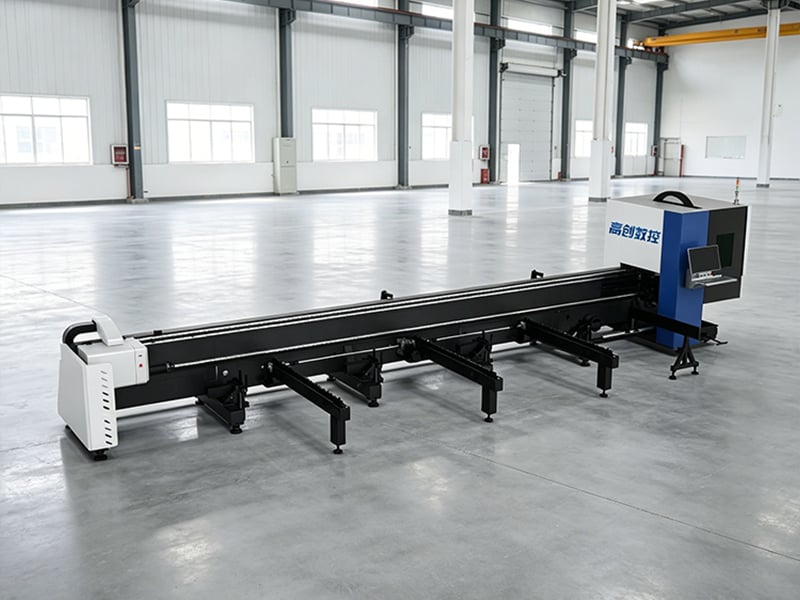
Most modern tube lasers run on fiber laser sources, delivering a concentrated, narrow laser beam. Supported workpieces include round tube, square tube, rectangular tube, oval pipe, angle steel, channel steel and other structural sections. Common materials: mild steel, stainless steel, aluminum and brass.
Core Advantages of Fiber Tube Lasers Over Traditional Methods
1. One-step processing, fewer secondary operations
This is the biggest ROI driver. A tube laser can cut lengths, drill holes, cut slots, create saddle joints, add notches and prepare beveled weld edges in a single program. Parts often come off the machine nearly burr-free, removing separate sawing, drilling and deburring stations. Less handling means fewer errors and less labor timeTRUMPF.
2. Superior precision and repeatability
Standard industrial tube lasers deliver positioning accuracy around ±0.03 mm. Consistent CNC control ensures every tube part matches the CAD drawing, batch after batch. This is critical for frame assemblies, fitness equipment, automotive tubing and architectural metalwork where poor fit-up kills welding speed and quality.
3. Higher speed and throughput
Fiber laser cutting runs far faster than sawing or plasma, especially on thin and medium wall metal. Combined with automatic loading and unloading systems, tube lasers keep production running with minimal operator attendance. Shops report total cycle time reductions up to 80%+ on complex tube parts compared to conventional workflows.
4. Less material waste
The laser kerf is extremely narrow. Smart CAD nesting software arranges parts along the tube stock to minimize scrap. For expensive stainless steel and aluminum tubing, this material saving directly improves profit margins.
5. Design freedom for complex geometries
With tube laser technology, you are no longer limited to straight cuts and simple holes. Mitre joints, intersecting saddle cuts, decorative cutouts and custom connection features are all programmable. Fabricators can bid more complex jobs and serve new markets that were previously uneconomical.
Main Industries Using Tube Lasers
- Fitness equipment and bicycle frames
- Automotive chassis, exhaust and roll cage components
- Agricultural machinery and construction equipment
- Architectural metalwork, railings and furniture frames
- Medical equipment, racking and storage systems
- Steel structure and prefabricated building profiles
Key Features to Compare When Shopping for a Tube Laser
When evaluating CNC tube lasers, focus on these practical specs rather than laser power alone:
- Tube diameter and length capacity: Confirm the machine can handle your most common stock size (e.g. 20–220 mm round tube, 6 m standard length).
- Chuck design: Single-chuck, double-chuck or three-chuck models. Three-chuck systems deliver better stability for long, heavy profiles.
- Automation option: Semi-automatic loading for small shops, full bundle loading + auto-unloading for high-volume production.
- Laser power: 1500W–3000W works well for thin and medium wall steel; 4000W–12000W for thick walls and heavy structural profiles.
- Software: Look for user-friendly tube CAM software with automatic nesting, collision detection and bevel cutting support.
- Service and spare parts: Reliable after-sales support matters a lot for industrial laser equipment.
Common Misconception: Tube Lasers Are Only for High-Volume Production
Many small job shops delay buying because they think tube lasers are only for large factories. The reality: even mixed small-batch orders benefit heavily. Quick CAD programming, zero tool changeover and less rework make custom tube jobs profitable. Many mid-size fabricators see payback within 12–24 months after replacing manual tube processing lines.
Final Thoughts
Tube lasers have redefined what is possible for metal tube fabrication. They merge speed, precision and flexibility into one machine, cutting labor, scrap and lead times at the same time. If your quote margins are squeezed by slow tube processing or you lose complex tube jobs to competitors, a fiber tube laser is worth a serious technical review.